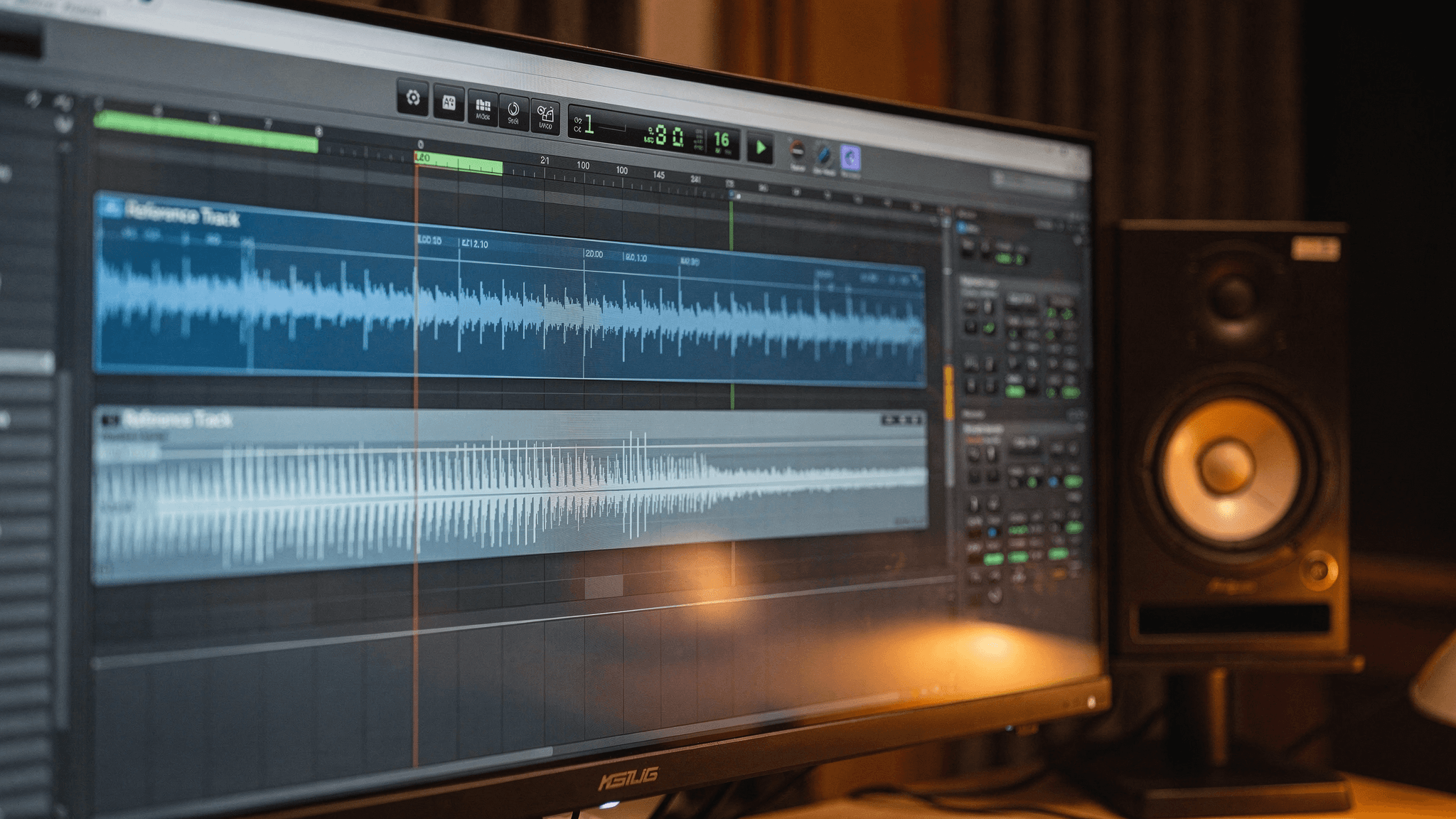
The only guide you need to actually use reference tracks correctly.
"Use a reference track" is some of the most repeated advice in mixing, and also some of the most frequently misapplied. Most people load up a favorite song, listen to it once at the start of a session, nod, and move on — which does almost nothing. A reference track is only useful if it's used as a measurement tool, not a mood board. Used correctly, it's one of the fastest ways to catch a mix decision that only sounds right because you've been sitting in the same room, at the same volume, listening to the same track, for the last three hours.
What a reference track is actually for
A reference is a known quantity — a professionally mixed and mastered track you're deeply familiar with — that you A/B against your own mix to catch drift. Drift happens constantly and invisibly: your ears adapt to whatever tonal balance you've been listening to, your perception of loudness shifts as a session goes on, and after enough hours your own mix starts to sound "right" simply because it's familiar, not because it's correct. A reference interrupts that adaptation by giving your ears something external to compare against — something that hasn't been slowly recalibrating your judgment for the last three hours the way your own mix has.
A reference track doesn't tell you what your mix should sound like. It tells you what your ears have stopped noticing.
Pick references that share your song's DNA, not just its genre
The single most common mistake is choosing a reference based on genre alone. A "reference" should match your track's actual arrangement density, tempo, and vocal placement as closely as possible — a sparse ballad and a wall-of-sound anthem in the same genre will have completely different mix priorities, and comparing one against the other will send you chasing a balance that doesn't apply to your song. Build a small rotating library of three or four tracks you know intimately, ideally ones close in instrumentation and energy to what you're currently working on, rather than reaching for whatever's popular this month.

Level-match or the comparison is meaningless
This is the step almost everyone skips, and it invalidates the entire exercise when they do. Human hearing perceives louder audio as better audio almost automatically — fuller low end, more "punch," more excitement — regardless of whether the mix is actually better. If your reference track is playing back louder than your own mix, of course it sounds bigger and more polished; you're not comparing mixes, you're comparing volumes. Use a level-matching plugin or manually gain-stage the reference to match your mix's perceived loudness (not just its peak level) before you draw a single conclusion from the comparison. Skipping this step is the single fastest way to make a reference track actively harmful instead of useful.
Compare in short bursts, not full listens
Long-form A/B listening — playing your whole mix, then the whole reference, then your whole mix again — mostly just re-triggers the same adaptation a reference is supposed to prevent. The useful method is short: ten to fifteen seconds of your mix, an instant switch to the same section of the reference, back again, focusing on one specific element each pass — low-end weight, vocal presence, stereo width, high-frequency brightness. Quick switches catch differences your ears would otherwise average out and forget.
What a reference can't do for you
A reference track will catch tonal drift, loudness mismatches, and translation gaps you'd otherwise miss. It will not fix a bad room, a bad performance, or a bad arrangement, and it's not a substitute for critical listening skills built over time — it's a check against your own ears, not a replacement for them. Treat it as a calibration tool you return to periodically through a session, not a crutch you lean on for every decision, and it earns its place as one of the cheapest, most effective tools in the entire mixing process.